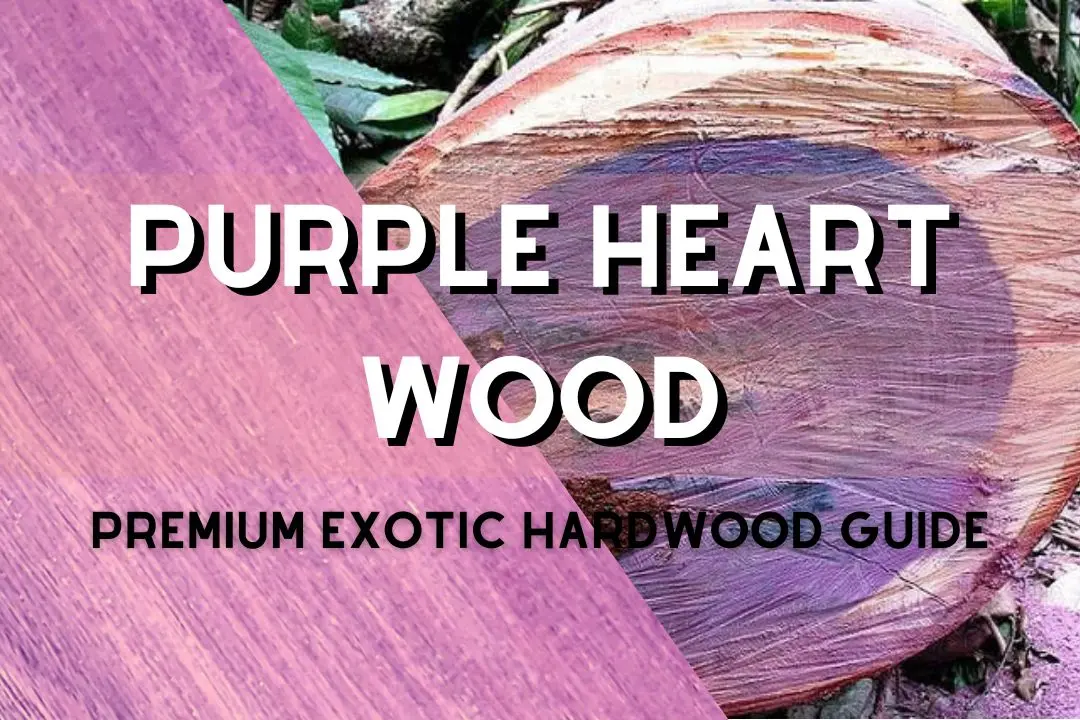

Purple heart wood is a dense tropical hardwood (Peltogyne spp.) known for heartwood that shifts from dull brownish-purple to a deeper purple after light exposure, plus high hardness for wear-heavy projects. It’s commonly used for accents, furniture, and purple heart wood flooring, but it can dull tools, burn during machining, and lose color without UV-aware finishing.
Table of Contents
Below is a practical guide to where it grows, how the color really behaves, what the numbers mean for your build, and the finishing steps that keep the purple looking intentional instead of muddy.
Purple heart wood at a glance
Peltogyne species
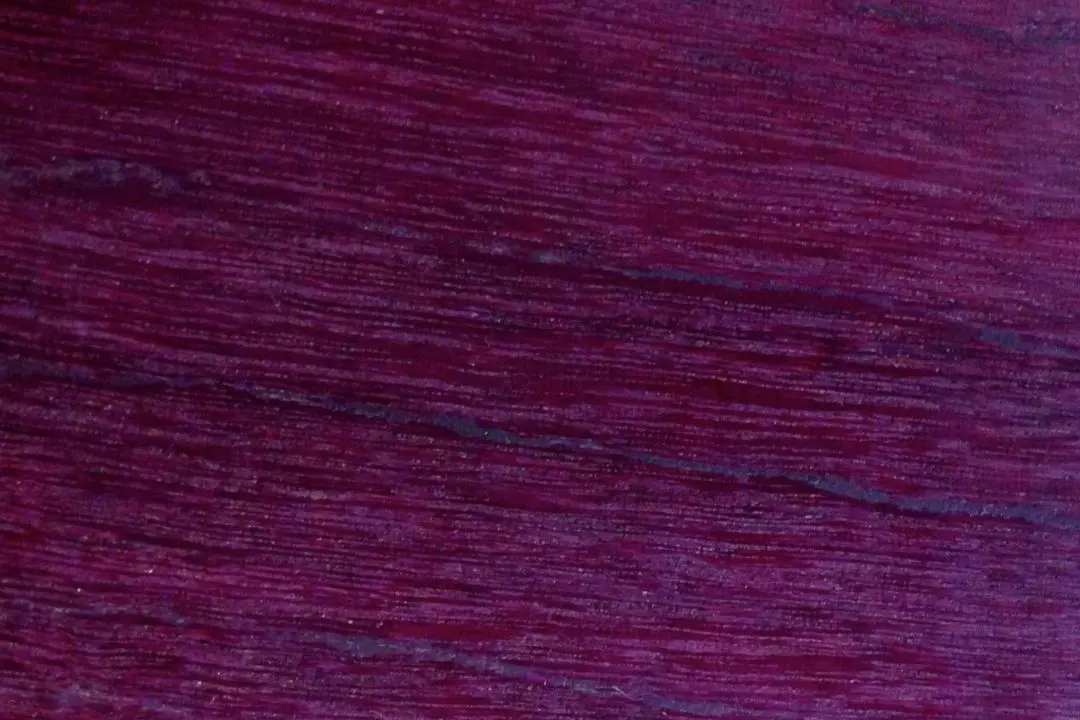
Purpleheart comes from the Peltogyne genus (often sold simply as “purpleheart”), which includes multiple commercial species that can vary in how quickly they color up and how interlocked the grain feels under a hand plane. In the shop, boards from different sources can look similar at purchase and still finish differently—one reason I label offcuts by supplier once I find a batch that behaves predictably.
For a fast cross-check of typical appearance, grain, and movement values, I keep Wood-Database’s purpleheart profile bookmarked and compare it to the shipment in front of me before I commit to a wide panel glue-up.
Color change
Freshly milled purpleheart rarely looks “purple-purple” at first; it often starts gray-brown or muted violet, then shifts as oxygen and UV light trigger surface chemistry. You’ll see the change over days near a sunny window, and you can speed it up with controlled light exposure—just know that too much heat during sanding can push the color the wrong direction (toward brown) before finish ever hits the wood.
One beginner mistake is finishing a piece immediately after milling and then panicking when it looks flat or slightly brown. I let parts sit after final surfacing, then do a final light scuff right before topcoat so the color and the scratch pattern don’t fight each other under raking light.
Grain and texture
Expect medium-fine texture with a natural luster; grain runs straight on some boards and wavy or interlocked on others. Under a sharp smoother, straight-grain pieces can peel off long, glassy ribbons, while interlocked areas tend to “chatter” and tear—your fingertips feel it as little ridges that show up the moment finish hits.
If you’re matching boards for a tabletop or a flooring run, look at the long edges for grain direction and flip boards for the calmest face. That small step reduces tearout and also helps color look more uniform once light starts aging the surface.
Where does purple heart wood come from
Native range
If you’re asking where does purple heart wood come from, its native range is the tropical forests of Central and South America (commonly listed across areas such as Mexico through Panama and into countries like Brazil, Guyana, and Suriname). That origin matters in use: tropical growth conditions typically produce dense, tight material that behaves differently than many domestic hardwoods when you machine it or try to stain it.
For a region-specific overview and forestry context, the Guyana Forestry Commission’s purpleheart page is a useful reference point when you’re checking species names and trade descriptions.
Purple heart wood tree
The purple heart wood tree is a large canopy/emergent tree in its native forest, and commercial boards are mainly heartwood—sapwood is usually a pale cream band that stands out hard against the purple. On finished projects, that sapwood can be either a feature (high-contrast striping) or a flaw (a “random blond edge”), so I decide early and keep sapwood either consistently included or consistently excluded.
Beginners often assume the pale section will darken into purple over time. It can tone slightly, but it won’t reliably match heartwood—if you need a uniform floor or panel, avoid boards with wide sap bands or plan to rip them out for narrow accent strips.
Export and compliance
Imported tropical hardwoods carry paperwork risk: species grouping, chain-of-custody, and legal harvest documentation can vary by supplier. If you’re building for a client (or any job that needs LEED/FSC-style documentation), ask for documentation up front and keep it attached to the project file—trying to backfill compliance after the boards are cut is where purchases get messy.
A practical workaround: buy all visible boards for one project in a single lot, then buy extra for repairs later. Mixed lots can differ in hue and oxidation rate, which shows up as “patchwork” in sunlight even if the milling quality is excellent.
Purple heart wood properties and specs
Density and weight
Purpleheart is very dense, which is why it feels almost “cold” and heavy on the bench compared to maple or oak. That density helps wear resistance and crisp edges in joinery, but you’ll feel it when handling long planks, shipping orders, and clamping wide glue-ups—your clamps and cauls need to be placed with intent because the assembly doesn’t “float” into position.
Air-dry density is often cited around 880–960 kg/m³ at 12% moisture content, which lines up with the way it sinks your fingernail test and how reluctantly it accepts fasteners without a pilot hole.
Janka hardness
The Janka hardness is commonly reported in the ~1,860–2,520 lbf range depending on the specific species/source. For floors and tabletops, that means dents from chair legs and dog nails are less common than on softer woods—but it also means hand-sanding takes longer and burn marks happen sooner if your abrasives glaze.
If you want context across other species, compare it against the site’s wood hardness scale to set realistic expectations for tool wear and daily abuse.
Strength metrics
Strength numbers matter when purpleheart is doing real work (stair nosings, thin shelves, long spans, bed rails). Typical published figures include MOR around 19,000–22,000 psi and MOE around 2.42–2.94 million psi; that stiffness is why narrow parts feel “dead straight” once acclimated, but it’s also why brittle-looking failures can happen if you run screws too close to an edge without a proper pilot and countersink.
If you’re mixing woods in one assembly, remember stiffness mismatch can telegraph as seasonal seams. Purpleheart’s movement isn’t wild, but pairing it with very soft, high-movement material often creates witness lines at glue joints after a heating season.
| Property | Typical published range |
|---|---|
| Air-dry density (@ ~12% MC) | 880–960 kg/m³ |
| Dried weight (common citation) | ~905 kg/m³ (56.4 lb/ft³) |
| Janka hardness | 1,860–2,520 lbf |
| MOR (bending strength) | ~19,000–22,000 psi |
| MOE (stiffness) | ~2.42–2.94 million psi |
| Shrinkage (radial / tangential / volumetric) | ~3.8% / 6.4% / 10.6% |
Shrinkage and stability
Published shrinkage values (about 3.8% radial and 6.4% tangential) point to moderate movement and a tangential/radial ratio around 1.7, which usually behaves evenly when properly dried. Real-world stability still depends on moisture swing: a board that reads 6–7% MC in a dry shop can swell fast in a humid install area, so I acclimate it to the jobsite conditions before final milling for flooring or built-ins.
A common mistake is milling to final thickness immediately after delivery. A better workflow is: rough mill, sticker-stack, wait, then final mill—purpleheart rewards patience with flatter panels and fewer “mystery cups” after glue-up.
Cost per board foot
Expect premium pricing: purpleheart often shows up around $14 to $45 per board foot depending on thickness, grade, and supply chain. The spread is big because clear, wide, uniform-color stock commands a lot more than narrow or sap-streaked boards, and shipping weight adds real cost that you feel most on long flooring orders or thick slabs.
If you’re budgeting a project, price out waste honestly. A “cheap” batch that needs heavy ripping to remove sapwood can end up costing more per usable inch than a pricier, cleaner bundle.
Durability, wear, and weathering
Rot and insects
Purpleheart is usually rated very durable in decay resistance with good insect resistance, which is why it shows up in demanding applications and holds up well to day-to-day abrasion. Indoors, that durability mostly translates to fewer dents and a cleaner edge at corners; outdoors, it means the wood itself can last, but the finish system becomes the weak link.
One risk beginners miss is fastener choice: iron-containing fasteners can stain dense tropical woods in damp conditions. Stainless or coated fasteners reduce black streaking, especially on exterior trim or porch details.
Marine borer risk
Don’t confuse “durable” with “invincible”—purpleheart can be susceptible to marine borers in saltwater exposure. If you’re thinking about docks, pilings, or constant splash zones, you need species selection that’s proven in marine conditions and a build that allows inspection and replacement instead of assuming the lumber alone solves it.
For marine jobs, I also avoid trapping water: leave drainage paths, keep end grain sealed, and design so hardware doesn’t create pockets where wet grit sits and grinds the surface like sandpaper.
UV fade and finish
UV exposure is the double-edged sword: it helps purpleheart “purple up,” then later it can push the surface toward brown if left unprotected. Indoors, you’ll see it as lighter rectangles under rugs or darker strips near sunny windows; outdoors, uncoated surfaces can lose that dramatic hue faster than most clients expect.
A UV-inhibiting topcoat slows the shift. The trade-off is maintenance—film finishes can peel outdoors, while penetrating oils are easy to refresh but won’t lock color in as strongly as a quality UV-rated system.
Workability and finishing tips
Cutting and machining
Purpleheart machines best with sharp cutters and controlled feed. On a jointer or planer, I take lighter passes than I would in ash or walnut; the wood’s density makes it tempting to “just push through,” but that’s how you get chatter, torn grain, and heat checks that show as dull streaks after finishing.
Interlocked grain is the edge case: it’ll tear even with sharp knives if the cut is aggressive. A helical head helps, and skewing the board on a jointer (where safe) can reduce tearout enough to save thickness.
Tool dulling
Expect moderate tool dulling. Router bits that feel crisp in soft maple can start leaving fuzzy edges on purpleheart after a short run, and that fuzz turns into dark burnished patches when you sand. I keep a “tropical hardwood” sharpness schedule: swap/rotate bits sooner, then resharpen in batches instead of trying to limp through one more pass.
Beginners often blame the wood for scorch marks when the real culprit is a dull bit plus a tiny hesitation. Keep the work moving, take multiple shallow passes, and use a backer to prevent edge blowout.
Resin and heat
Purpleheart can produce gummy resin when overheated, which you’ll notice as a sticky drag on sandpaper and a faintly sweet, sharp smell as the abrasive warms up. Once the paper loads, it stops cutting and starts polishing—then you get heat, then more resin, and the cycle keeps going.
The fix is simple but non-obvious: change paper early, vacuum dust often, and don’t lean your body weight into the sander. A light touch keeps the surface cool and preserves the clean purple tone.
Sanding and finishing
For most projects, I sand to a consistent grit progression and stop before the surface gets over-burnished. On dense woods, sanding too fine can reduce finish adhesion, especially for film finishes—so the goal is uniform scratch, not a mirror surface before topcoat.
A practical finishing workflow that avoids surprises:
- Surface the parts, then let them rest so color can shift and moisture can equalize.
- Do a final light sanding pass right before finish to remove handling oils and minor oxidation.
- Apply a compatible sealer/topcoat system; prioritize UV inhibitors if color matters.
- Test on offcuts from the same board—purpleheart can vary more than people expect.
If you’re comparing other dramatic-color woods for accents, the behavior is different from padauk wood, which can also shift with light but tends to move from orange/red toward brown rather than settling into purple.
Common uses of purple heart wood
Furniture and cabinetry
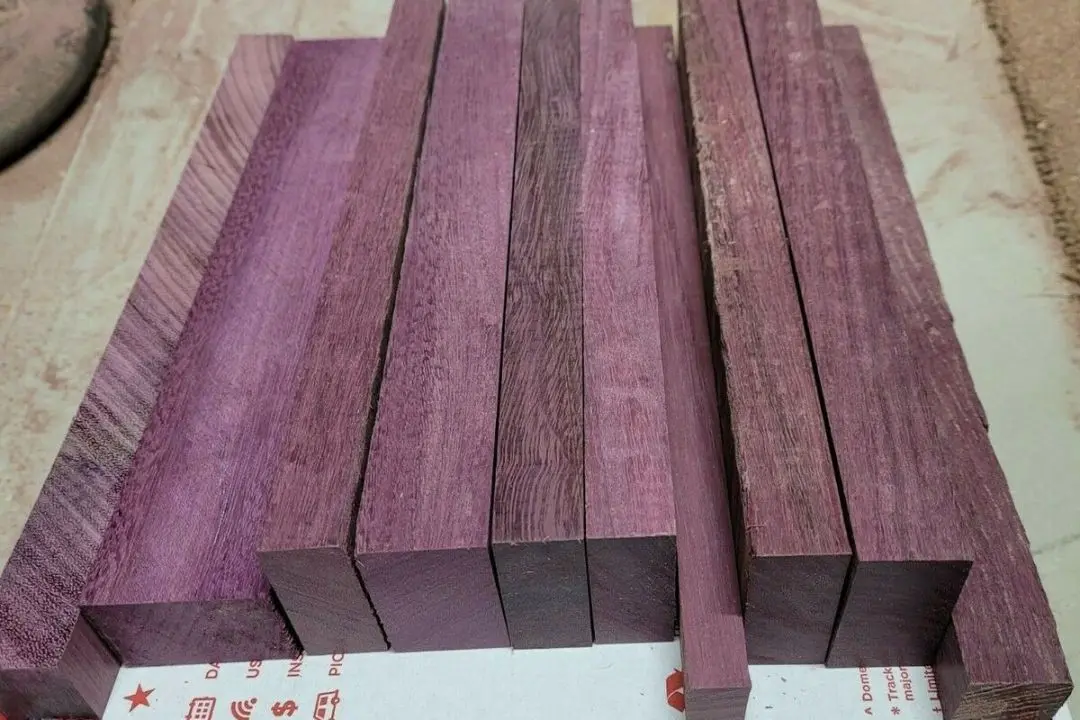
For furniture, purpleheart shines as accent material: inlays, legs, pulls, edging, and contrasting frames where the purple reads as intentional design. Full purpleheart casework is possible, but the weight adds up fast—large doors feel heavier on hinges, and wide panels demand careful grain selection to avoid tearout that only shows after finish reflects light.
If you want small, wide boards that are convenient for panels and cutting-board-sized glue-ups, this size is practical for real shop layouts:
Purple heart wood flooring
Purple heart wood flooring performs well in traffic thanks to hardness and density, and it delivers a look you can’t fake with stain alone. The trade-off shows up in installation and finishing: it’s heavy to move, it can splinter if you rush cuts, and it needs a UV-aware topcoat plan so the floor doesn’t drift toward dull brown in the sunniest parts of the room.
If you’re prototyping thresholds, vents, or stair parts, shorter straight-grain boards are handy for mockups before you order full flooring runs:
Craft and specialty projects
For small work, purpleheart’s color contrast makes it a favorite for knife scales, pens, inlay lines, jewelry, and laminated handles. One caution: thin pieces can heat up fast on a belt sander, so I shape slowly and keep a cup of water nearby for a quick cool-down to avoid resin smears and brown scorch marks.
These sizes cover common craft workflows like veneering, scroll saw blanks, and small cutting boards:

Purpleheart Veneer Sheets 1/8 inch 5 by 9 inch
- Thin 1/8 inch sheets ideal for laminating and inlay work
- Consistent 5 by 9 inch size for precise crafting
- Smooth surface sands and stains evenly
- Exotic purple tone adds natural color to projects
- Perfect for model making, jewelry, and decorative accents
 Buy on Amazon
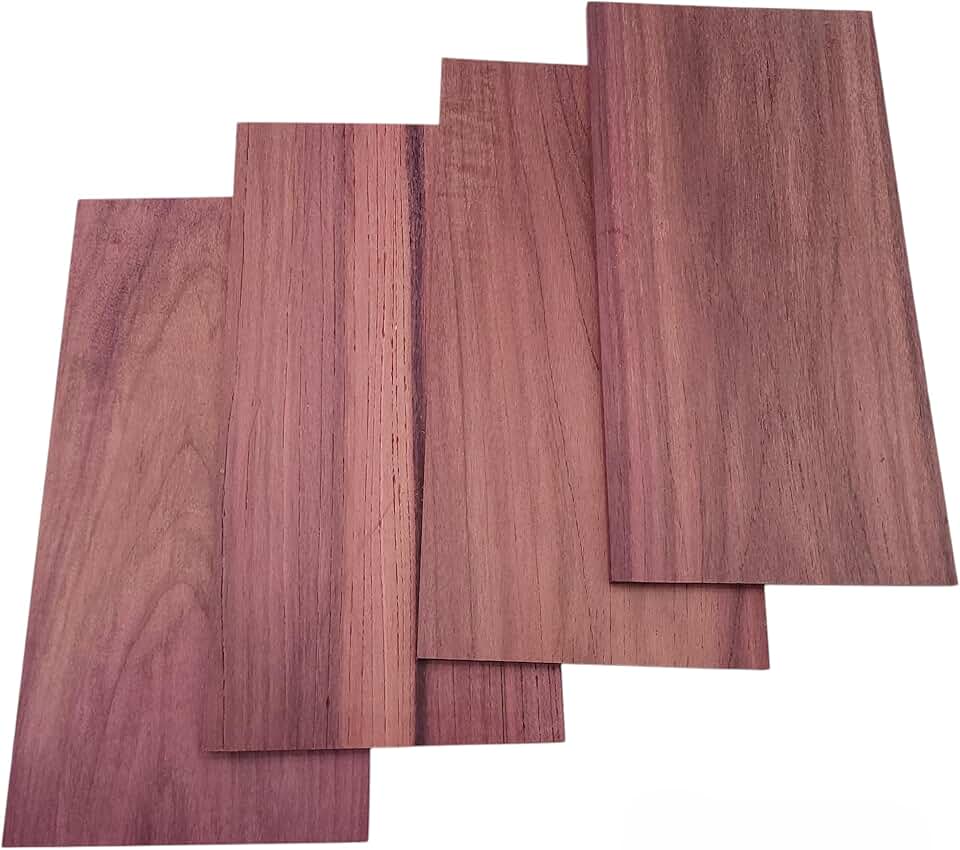
Purpleheart Project Planks 12 by 6 by 1/4 inch 4-Pack
- Thin 1/4 inch planks ideal for carving and laser work
- Uniform thickness for precise edging and joining
- Smooth unfinished surface accepts stain and paint well
- Exotic hardwood adds striking color to crafts
- Great for scroll saw projects, plaques, and inlays
Buy on Amazon

Woodchucks Purpleheart 6-Pack 3/4 inch by 2 inch by 16 inch
- Six boards supply plenty of material for larger runs
- Hard, wear resistant wood suitable for cutting boards
- Uniform sizing simplifies layout and assembly
- Rich color accents small furniture and kitchen projects
- Machine ready with straight grain for clean tool cuts
Buy on Amazon
Purple heart wood flooring: fit and tradeoffs
Traffic and denting
For busy homes, purpleheart handles daily abrasion well—shoes, rolling chairs (with the right wheels), and pet traffic show less denting than many mainstream hardwoods. The real risk is grit: dense wood won’t dent easily, but sand-like debris will still scratch the finish, so entry mats and frequent vacuuming do more than people expect.
One mistake I see is skipping felt pads because “the wood is hard.” The floor might survive, but the finish doesn’t—protect the coating and you protect the look.
Color preservation
Color preservation is a finish system problem, not a wood problem. If you want purple to stay purple, pick a topcoat with UV inhibitors and plan for sun management (window film, rugs rotated seasonally, or shades during peak UV hours). Without that plan, you’ll get visible tone shifts—especially along glass doors and south-facing windows.
For a quick reference on basic characteristics and why the color behaves the way it does, Purple Heart Wood Characteristics is a straightforward overview; I still recommend testing your actual finish on your actual boards because different batches oxidize at different rates.
Installation considerations
Installation goes smoother when you treat purpleheart like a dense exotic: predrill where needed, keep blades sharp, and control moisture before boards come out of the stack. I also plan transitions carefully—at doorway thresholds the wood’s hardness is great, but that same hardness can chip at edges if you let an undercut saw wander or if you force boards tight against an uneven subfloor.
Flooring-specific beginner traps and fixes:
- Trap: installing before acclimation; Fix: acclimate to the home’s normal HVAC conditions, then rack boards for color/grain consistency.
- Trap: dull blades causing burn and tearout; Fix: change blades early and reduce feed pressure on crosscuts.
- Trap: ignoring sunlight patterns; Fix: pick UV-inhibiting topcoat and plan rug placement so the change looks even.
- Trap: no test board; Fix: finish a sample panel, place it in sun/shade for a week, then decide.
Lessons Learned in Practice: Purpleheart in real shops and homes
The biggest surprise with purpleheart is how fast heat shows up. A random-orbit sander that feels calm on walnut can make purpleheart feel warm to the touch in under a minute, and you’ll smell that sharp, slightly sweet “hot wood” scent right before the paper loads and the surface starts drifting brown—so I sand in short passes, vacuum often, and keep fresh discs within arm’s reach.
Glue-ups bring their own friction. Dense edges can look perfectly jointed and still starve a joint if clamp pressure is uneven; I’ve had better luck with a consistent, moderate clamp line and a glue that gives enough open time to position heavy parts without panic. After cure, I scrape squeeze-out early—purpleheart’s dark glue smears can telegraph under clear finishes as shiny streaks that only appear when a light hits at an angle.
Color matching is where projects either look premium or cobbled together. Boards from different lots can age at different speeds, so I lay out parts in the same lighting the piece will live in, then I “sun test” the most visible faces for a day to see which ones jump purple and which ones stay subdued. That one step prevents the classic mistake of installing a floor or tabletop and later noticing one plank looks like eggplant while the next reads more chocolate.
Finally, I treat purpleheart dust with respect. Fine sanding dust can irritate skin and lungs; if you’ve ever wiped your forearm after milling and felt that dry, itchy film, you’ll know why I run dust collection, wear a real respirator, and change shirt sleeves after a long session—simple habits that keep the material enjoyable to work with.
FAQs
Where Does Purple Heart Wood Come From?
Purpleheart comes from Peltogyne trees native to Central and South America.
It grows in tropical rainforests—notably in Brazil, Bolivia and Paraguay—and is harvested for lumber. Sourced logs are milled and dried before use; verify sustainable sourcing for conservation. Look for certified suppliers or reclaimed pieces to reduce environmental impact.
Why Does Purple Heart Wood Change Color?
Purpleheart wood changes color because ultraviolet light and oxidation transform its original purple pigments into brownish tones.
Fresh-cut wood is brighter purple, while exposure to air and sunlight alters pigments over days to months. You can slow or restore color by applying UV-blocking finishes or using a clear coat with UV inhibitors; light sanding briefly reveals the original hue.
Is Purple Heart Wood Good For Flooring?
Yes, purpleheart is suitable for flooring due to its high hardness and striking appearance.
Its density makes it wear-resistant and long-lasting, but it is heavy and can be harder to acclimate and fit than softer species. Professional installation, proper acclimation, and a durable, UV-resistant finish will reduce movement and color changes for a stable floor.
Is Purple Heart Wood Hard To Work With?
Purpleheart can be challenging to work with because it is very dense and quickly dulls cutting tools.
Use sharp carbide cutters, take light passes when routing, and pre-drill for screws to avoid splitting; dust can be irritating, so wear a mask. Finishing may require more sanding and care; experienced woodworkers manage these issues more easily.
How Durable Is Purple Heart Wood Outdoors?
Purpleheart is naturally durable and resistant to decay, making it appropriate for many outdoor uses.
However, its purple color will fade without UV protection and it can move with moisture changes, so sealed, ventilated installations work best. For long-term outdoor use or ground contact, use appropriate finishes, regular maintenance, or choose engineered assemblies designed for exposure.